Sustainable Simplicity Square Eco-Friendly Sugarcane Pulp Tray for Everyday Use

In today’s world, eco-conscious consumers and businesses are increasingly searching for alternatives to plastic and foam. The Square Eco-Friendly Sugarcane Pulp Tray in natural color offers a practical and sustainable solution for serving and packaging food. Made from 100% biodegradable sugarcane bagasse, this compostable tray is perfect for frozen meals, takeout, or deli displays, all while minimizing environmental impact.

This sugarcane pulp tray is not only compostable and PFAS-free but also sturdy and reliable for a wide range of food applications. Whether you're storing hot entrees or freezing pre-packaged meals, the tray holds up under various temperatures and maintains its shape without leaks or breaks. Its natural, minimalist appearance also adds a clean and modern touch to your food presentation.

With its eco-friendly design, the tray supports a zero-waste lifestyle and is an excellent option for restaurants, food manufacturers, catering businesses, and environmentally aware households. By switching to plant-based packaging, users contribute to a more sustainable food industry—helping reduce landfill waste and dependence on petroleum-based plastics.


At Biosettings, we are proud to offer innovative, earth-friendly food packaging solutions that don’t compromise on quality. Our Square Eco-Friendly Sugarcane Pulp Tray is a reflection of our commitment to sustainability and responsible sourcing.

Anhui Newman launches new products—NM-Carbomer Aqua25

What best describes the difficulties facing the beauty industry today? Maybe "mountains" is more appropriate. Although it falls into the stereotype, it does accurately express the difficult and heavy survival and development of beauty companies under the environment of economic downturn and industry volume. This heavy, especially in product development and iteration.

On the one hand, as the "core" of the product, beauty raw materials have also failed to escape the pain of low level competition such as roll cost and roll price, in order to save costs, or to seize users, false additions, prohibited additions and other phenomena frequently appear, truly innovative raw materials may be difficult to be widely used because of cost problems, beauty raw materials innovation power, or thus greatly suppressed. On the other hand, in the field of efficacy that can best capture the minds of consumers, conceptual speculation is still prevalent, and precise skin care that can better capture user needs and alleviate their pain points is on the rise, and there are still many things to be solved and improved.

At present, the innovation and iteration of cosmetic raw materials and the breakthrough of core technologies have become the key elements to promote product upgrading and meet the diversified needs of consumers. Cosmetic formula is the core, and raw materials are the basis of this core.

 Carbomer /Carbopol Aqua 25/30/SF-1/10/20

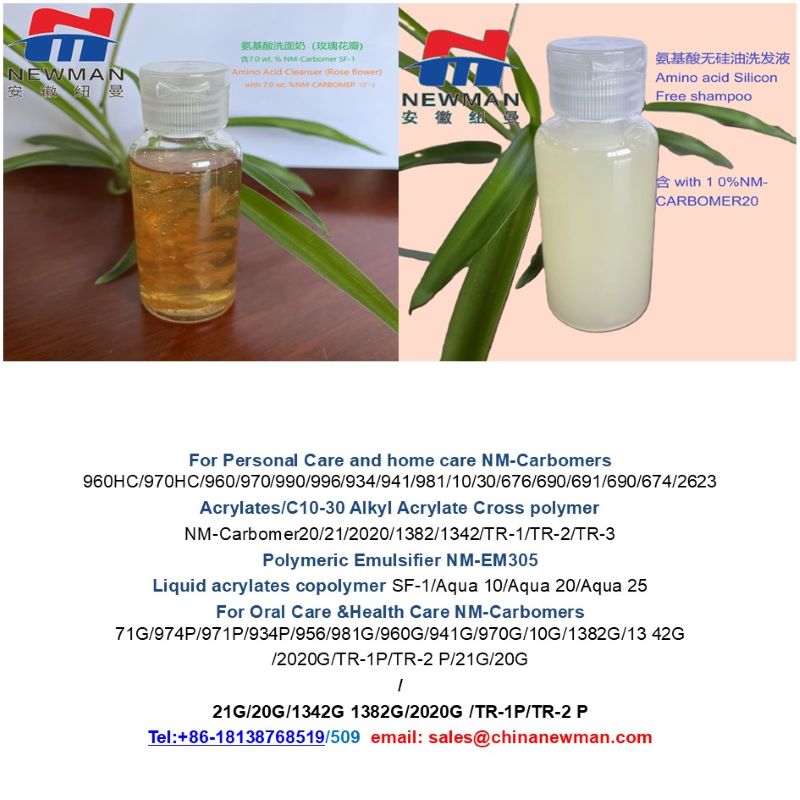
We, Anhui Newman Fine Chemicals Co., Ltd., are the top leading manufacturer of carbomer and acrylates copolymer. Anhui Newman has been producing carbomer products for the past 14 years, Product quality is constantly improved and constantly innovative. Now we are launching a new type of an anionic hydrophobically modified alkali-soluble acrylic polymer emulsion (HASE) NM-Carbomer Aqua 25,INCI Name: Acrylates/ Steareth-20 Methacrylate Crosspolymer,like other liquid  acrylates copolymer such as NM-Carbomer SF-1NM-Carbomer Aqua10, and NM-Carbomer Aqua 20, provides a liquid, cold processable product with a solid content of 30%, have  excellent thickening and stability properties. They  instantaneously thicken upon neutralization providing ease of handling and increased manufacturing efficiency. NM-Carbomer Aqua 25 specifically imparts efficient thickening properties for amino acid surfactant systems, and has excellent clarity gels , which can be extensively applied for formulations containing high levels of surfactant.

 Here is  NM-Carbomer Aqua25  performance and features:

 Skin cleansing 

 Amine acid surfactant system

 Easy-to-Use Liquid Form

 Thickening and Flow Control

 Highly associative and very pseudoplastic

 Synergistic interaction with surfactants, particulates and hydrophobic raw materials

High surfactant synergy

 High-transparent Formulations

 pH Flexibility

 Surfactant Compatibility

Recommended Applications

 Facial cleansers

 shampoos

 Bath foams

 liquid soaps

 Lotions

 Moisturizing creams

 Shampoos

 Shower gels

 hand cleaners


What type of blanket is best for picnics?

picnic blankets


What Type of Blanket Is Best for Picnics?

Picnics are a cherished way to enjoy the outdoors, whether in a sun-drenched park, a shady forest, or a breezy beachside. Yet, the success of a picnic often hinges on one essential item: the blanket. A well-chosen picnic blanket not only provides comfort but also withstands environmental challenges. So, what makes the perfect picnic companion? Let’s explore the key features to consider.

Durability and Material Matter
The foundation of a great picnic blanket lies in its material. For rough surfaces like grass, sand, or gravel, a durable, tear-resistant fabric is non-negotiable. Polyester blends are popular for their strength and weather resistance, while canvas offers a sturdy, classic option. However, pure canvas can be heavy and less portable. Modern hybrids, combining polyester with a waterproof backing, strike a balance between resilience and convenience.

Waterproofing: A Must-Have Feature
Grass can be damp, and beaches are often sandy and moist. A waterproof or water-resistant layer beneath the top fabric is crucial to keep you dry and comfortable. Many blankets feature a PVC or polyurethane-coated bottom, acting as a barrier against moisture, dew, or spills. This feature not only protects you but also prevents the blanket from absorbing ground moisture, ensuring it dries quickly after use.

Portability and Ease of Transport
A picnic blanket’s practicality extends beyond its surface. Look for lightweight options that fold compactly into carry bags with handles or straps. Some designs include built-in storage pockets for utensils, napkins, or even a bottle opener. For hikers or those traveling far, a blanket that doubles as a tote bag—with reinforced corners or straps—can be a game-changer, eliminating the need for multiple items.

Size and Comfort Considerations
Consider how many people will use the blanket. A family picnic demands ample space, while a solo outing might suit a smaller, portable option. Additionally, think about thickness. A thin blanket might suffice on dry grass, but a padded or fleece-lined version adds comfort on harder surfaces like concrete or rocky terrain. Some blankets even include removable foam inserts for customizable cushioning.

Style and Aesthetic Appeal
While functionality reigns supreme, style isn’t irrelevant. Vibrant patterns, neutral tones, or themed designs can elevate your picnic’s ambiance. Opt for colors that resist fading from UV exposure, ensuring your blanket stays vibrant season after season.

Final Verdict
The ideal picnic blanket blends durability, waterproofing, portability, and comfort. For versatility, a polyester-canvas hybrid with a waterproof base and carrying straps checks most boxes. Add a touch of personal style, and you’ve got a recipe for countless memorable outings. So, the next time you plan a picnic, choose a blanket tailored to your needs—and let the adventures unfold!


What is the best material for a picnic blanket?

Selecting the right picnic blanket material is crucial for balancing comfort, durability, and practicality in outdoor settings. From sandy beaches to damp grassy fields, the ideal material must address key challenges like moisture resistance, ease of cleaning, and portability. After evaluating mainstream options, three materials emerge as top contenders: Oxford cloth, PVC-coated composites, and multi-layered fabric designs.


Oxford Cloth: The Durability Champion
Oxford cloth, particularly 600D nylon-based variants, dominates the market for its robust construction. Its high-density weave resists tears and abrasions, making it suitable for rough terrains. Brands like NatureHike and Mobi Garden utilize this material in their products, combining Oxford cloth with PVC or aluminum film backings to enhance waterproofing. For example, the NatureHike CNK2350WS010 model features a waterproof Oxford cloth top layer paired with a moisture-blocking aluminum film base, creating a barrier against damp ground. This material’s lightweight yet resilient nature allows it to withstand frequent machine washing without deformation, a key advantage for families with children.

PVC-Coated Composites: The Waterproof Specialist
PVC-based blankets excel in moisture resistance. The material’s non-porous surface repels water and spills, ensuring dry seating even on wet surfaces. However, pure PVC blankets often sacrifice comfort due to their rigid texture. Innovative designs, such as the FEISTEL 200x200cm model, address this by integrating a PVC base with a softer polyester top layer. This hybrid structure maintains waterproofing while improving tactile comfort. The downside lies in PVC’s environmental impact—some formulations may contain non-eco-friendly additives. Consumers should prioritize brands like FEISTEL, which use phthalate-free PVC coatings to mitigate health concerns.

Multi-Layered Fabric Designs: The All-Rounder
Three-layered blankets merge Oxford cloth, padding, and waterproof membranes to create versatile solutions. The top layer, typically made of abrasion-resistant Oxford cloth, shields against dirt and UV rays. The middle layer, often filled with cotton or polyester wadding, adds cushioning. The bottom layer, commonly a PEVA or aluminum film, blocks moisture. Models like the JD.com-exclusive 200x200cm picnic blanket exemplify this approach, offering machine-washable convenience and a 1kg lightweight design. While slightly bulkier than single-layer blankets, their enhanced comfort and adaptability make them ideal for extended outdoor stays.

Tailoring Your Choice to Usage Scenarios
For frequent travelers prioritizing lightweight durability, Oxford cloth blankets with reinforced seams are optimal. Families seeking hassle-free cleanup should opt for PVC-hybrid models. Multi-layered designs cater to users valuing all-day comfort. Regardless of choice, consumers should verify product certifications for safety and environmental compliance. By aligning material properties with specific needs, picnickers can ensure a seamless blend of functionality and enjoyment in nature.


What is the smallest and lightest portable chair?

In the field of outdoor products, the FEISTEL brand has launched a "pocket-level" portable chair with its innovative design and technological breakthroughs, redefining the portable standard for outdoor and daily use with its extremely small size and ultra-light weight. This product has become a lightweight benchmark among similar products through material innovation and structural optimization.


Core parameters: 1.7kg extreme lightweight
The FEISTEL portable chair uses an aviation-grade 22mm aluminum tube frame and ultra-light polyester tear-resistant fabric. The overall weight is only 1.7kg, which is equivalent to the total weight of three bottles of mineral water. This data is significantly better than mainstream products in the market. For example, although the Helinox Chair Zero is famous for its ultra-light weight of 0.9kg, FEISTEL has improved the support stability by thickening the tube diameter while maintaining a similar weight. The maximum load-bearing capacity is 150kg, which can meet the daily needs of most users. Its storage size is compressed to a cylinder with a diameter of 8cm and a height of 30cm, which can be easily stuffed into the side pocket of a backpack or mounted on the outside of a mountaineering bag, completely getting rid of the pain points of traditional folding chairs that "take up space and are difficult to carry".


aluminum camping chair

Structural innovation: modularization and functional integration
FEISTEL's design breakthroughs are reflected in three core innovations:

Quick-release pipe connection system: The traditional screw fixation is replaced by a snap-on joint, which takes only 10 seconds to unfold. When storing, there is no need to disassemble the pipe, and it can be folded directly.
Adjustable backrest angle: The chair back supports three-level tilt adjustment, which is suitable for different scenes such as reading and lunch break, breaking the industry inertia of "portability means sacrificing comfort".
Hidden storage bag: A waterproof storage bag is built under the chair surface to store small items such as mobile phones and water cups to avoid the burden of additional backpacks.
Application scenarios: Full scene adaptation from cities to wilderness
The lightweight characteristics of this product make it a multi-scene artifact:

Outdoor scene: It can be used as a temporary resting point when hiking and camping, and fishing enthusiasts can place it by the stream and match it with a non-slip foot pad to adapt to complex terrain.
Urban commuting: Office workers can use it as a spare chair in the office, and the volume after folding only occupies 1/4 of the desktop; photography enthusiasts can use it as a camera position auxiliary tool when shooting outdoors.
Emergency scenarios: Family reserves or vehicle-mounted emergency equipment, temporary seats during natural disasters or power outages.
Industry comparison: The art of balancing lightweight and practicality
Compared with similar products on the market, FEISTEL has significant competitive advantages:

Compared with tactical seats: For example, the hinata × redad vintage military chair has a unique style, but it weighs 2.5kg and lacks storage design. FEISTEL achieves better functional integration with lighter weight.
Compared with environmentally friendly models: ZEROGRAM recycled nylon chair is environmentally friendly, but it weighs 1.8kg and has no angle adjustment. FEISTEL achieves a better balance between lightweight and practicality.


FEISTEL portable chair redefines the boundaries of portable furniture with its extreme lightweight of 1.7kg, modular design and full-scenario adaptability. Whether it is the "lightweight" pursued by outdoor explorers or the "comfortable on the go" needed by urban people, this product shows the profound impact of technological innovation on lifestyle.


From Factory to Store How Our Paper Boxes Maintain Quality During Bulk Shipping

In the world of packaging, paper gift boxes and paper packaging boxes are more than just containers—they’re the first impression of your brand. For businesses that rely on bulk shipping, ensuring these boxes arrive in pristine condition is a top priority. At every step, from production to delivery, we implement rigorous quality control measures to protect your packaging and uphold your brand’s reputation. Here’s how we do it.


1. Raw Material Selection: The Foundation of Durability.Quality begins with the right materials. Our paper gift boxes are crafted from FSC-certified paperboard or corrugated cardboard, chosen for their strength and resilience. For high-end products like luxury paper packaging boxes, we use thicker, layered paperboard to prevent bending or denting. Each material undergoes stress tests to ensure it can withstand compression, humidity, and temperature changes during transit.

custom made paper gift boxes


2. Precision Manufacturing: Consistency in Every Fold During production, advanced machinery ensures uniformity in cutting, folding, and gluing. Even minor flaws—like uneven edges or weak seams—are flagged by automated systems. For custom paper boxes, templates are rigorously tested for structural integrity before mass production begins. This attention to detail guarantees that every box in a shipment meets the same high standards.

paper box packaging manufacturer

3. Strategic Packing: Protecting Boxes Inside-Out.Before bulk shipping, paper packaging boxes are carefully packed into larger corrugated cartons. To prevent shifting, we use partition inserts, foam padding, or air pillows. For delicate designs like embossed paper gift boxes, protective films or tissue paper are added to guard against scratches. Each carton is sealed with heavy-duty tape and labeled with handling instructions to minimize rough treatment.

paper shipping boxes

4. Climate-Controlled Logistics: Fighting Environmental Threats.Paper is sensitive to moisture and temperature. During shipping, we partner with logistics providers that offer climate-controlled containers to maintain stable humidity levels (ideally 30–50%). GPS-tracked vehicles ensure real-time monitoring, allowing rerouting in extreme weather. For international shipments, waterproof liners are added to counter condensation risks.

paper gift boxes

5. Testing the Journey: Simulating Real-World StressBefore approving a batch, we replicate shipping conditions. Boxes undergo ISTA-certified drop tests, vibration tests, and compression tests. For example, a stack of paper gift boxes must endure 48 hours under weights exceeding standard limits to confirm they won’t collapse.

paper gift boxes supplier


6. Sustainability Without Compromise .Even with robust packaging, we prioritize eco-friendly practices. Recyclable fillers and biodegradable films protect boxes while aligning with green values—a growing demand for custom paper packaging boxes.

From factory floors to store shelves, our custom print paper boxes are engineered to survive the journey. By combining durable materials, precision engineering, and smart logistics, we ensure your packaging arrives as flawless as it left our facility. Whether it’s a small batch of  luxury paper gift boxes or a large order of eco-friendly packaging, quality never takes a backseat.

Interested in stress-free shipping for your paper packaging? Let’s craft a solution that protects your products—and your brand.

What is an IGT camping table?

For outdoor enthusiasts seeking a fusion of functionality and creativity, the IGT camping table has emerged as a game-changer. Short for Iron Grill Table, this modular system redefines camping furniture by transforming a simple table into a dynamic "adult LEGO set" for outdoor kitchens and living spaces.

camping table oem


The IGT system centers around three foundational elements:


Modular Frames: Crafted from lightweight aluminum, frames come in three standard sizes—2-unit (64cm), 3-unit, and 4-unit configurations. Each "unit" acts as a building block, allowing users to mix-and-match components like grills, stovetops, or storage trays.
Adjustable Legs: Four height options (30cm, 40cm, 66cm, 83cm) cater to diverse scenarios, from bar-height dining to countertop-level cooking.
Expandable Surfaces: Optional extension boards—including rectangular side tables, corner panels, and trapezoidal modules—enable users to reshape the table into an island counter, communal dining area, or even a U-shaped workstation.


Versatility: Beyond Camping

The IGT’s adaptability transcends traditional camping use:

Outdoor Entertaining: Host a backyard BBQ with an integrated grill module, or extend the table into a 10-person banquet setup using corner connectors.
Indoor Creativity: Repurpose the table as a coffee bar, home office desk, or children’s craft station. The weather-resistant aluminum frames and optional bamboo tabletops blend seamlessly into interior design.
Compact Storage: When disassembled, the table folds into a 92.5×23×10cm package—smaller than a standard suitcase—making it ideal for RV storage or urban apartments.


Real-World Applications

Solo Adventurers: A 2-unit frame paired with a single-burner stove and a 30cm leg kit creates a minimalist cooking station, perfect for boiling water or brewing coffee.
Family Camping: Combine a 4-unit frame with a grill, sink, and storage modules to build a mobile kitchen island. Add extension boards to accommodate meal prep for 6+ people.
Emergency Preparedness: The sturdy 30kg load capacity and quick-assembly design make it a reliable disaster-relief table for cooking or medical supplies.


The Future of Modular Outdoor Living

Brands like Snow Peak and Naturehike have expanded the IGT ecosystem with accessories such as:

Height Adjusters: Eliminate awkward bending or stretching with push-button leg extensions.
Hanging Systems: Side-mounted hooks and shelves free up table space for utensils or condiments.
Collaborative Kits: Pre-bundled "starter packs" for coffee brewing, sushi-making, or wine tasting simplify setup for niche activities.


In essence, the IGT camping table embodies the ethos of modern outdoor culture: versatility without compromise. Whether you’re a weekend warrior, a DIY enthusiast, or a minimalist traveler, this modular marvel proves that a single piece of furniture can be the cornerstone of countless adventures.


What Is Faux Leather Made Of?

Artificial leather, also known as synthetic leather or faux leather, is a man-made material that mimics the texture of animal leather without containing any animal components. Due to its excellent water resistance and durability, it is widely used in the handbag industry.

Common materials used in artificial leather include PU, PVC, polyester, polyurethane, and certain natural fibers derived from plants.

PU Leather

PU leather is manufactured using two methods: dry processing and wet processing. Although the processes differ, both involve coating a base fabric with polyurethane.

PU Leather PU Leather


PVC Leather

PVC leather is produced by applying a layer of polyvinyl chloride onto a fabric backing. Compared to PU leather, PVC leather is more robust but offers less breathability.


Microfiber Polyester Leather

This material combines ultra-fine polyester fibers with polyurethane, resulting in a soft yet durable product. However, it tends to be more expensive.

Microfiber Polyester Leather

Plant-Based Leather

Transforming plant waste into leather is a relatively new technology developed in recent years. This method repurposes plant waste to create environmentally friendly leather alternatives. Common plant-based materials include apple waste, mushroom mycelium, cork leather, and pineapple fibers. These materials are characterized by their natural degradability and higher production costs.

What is the difference between a waterproof backpack and a water resistant backpack?

Generally, a waterproof backpack should have better water resistance than a water-resistant backpack.


A waterproof backpack can withstand temporary submersion without leaking, while a water-resistant backpack only resists splashes or light rain.

A waterproof backpack should meet at least IPX7 water resistance, while a water-resistant backpack only needs to meet IPX4.

Water Resistant Bag


IP Rating Explanation

The IP rating is an internationally recognized standard for water resistance, set by the International Electrotechnical Commission (IEC). The higher the IP rating, the better the water resistance. There is no strict standard in the backpack industry specifying what IP rating a product must have to be called "waterproof," so the difference between waterproof backpack and water-resistant backpack comes from a common understanding of these terms.

IPX7 vs IPX4 Testing Process

IPX7: The backpack’s zippers are closed, and it is submerged in water up to a depth of one meter (measured from the top of the backpack) for 30 minutes. Afterward, the backpack is taken out, and the interior should remain dry.

IPX4: The backpack is closed and sprayed with water in all directions (front, back, left, right, up, down) for 5 minutes in each direction, with a water flow rate of 10 liters per minute. After the test, the interior should remain dry.


It is clear that a IPX4 rated water-resistant backpack is sufficient for everyday situations, such as encountering rainy or damp weather. On the other hand, a IPX7 rated waterproof backpack is more suited for professionals who work in extreme conditions.

Industry Data-Global Aerosol Can Production Data Overview

Global Aerosol Can Production

According to the statistical report of the European Aerosol Alliance (FEA), the total global aerosol can production in 2023 will exceed 15.5 billion cans, ranking first in the world in terms of production in Europe. The total production has slightly decreased compared to last year, reaching about 5.288 billion cans, with the UK, Germany, and France accounting for over 55% of all aerosol production in Europe. In addition, major aerosol producing countries such as Italy, the Netherlands, and Spain produced over 4 billion cans of aerosols in 2023.

aerosol can data

The United States ranks second in the world in aerosol production, with a total production of approximately 3.752 billion cans. China ranks third in the world in terms of aerosol production. According to the latest statistics from the Aerosol Professional Committee of the China Packaging Federation, the annual production of aerosols in China will be approximately 2.475 billion cans in 2023. Brazil ranks fourth in the world in aerosol production, with a total production of approximately 1.202 billion cans, while Argentina ranks fifth with a total production of 864 million cans.

aerosol tin can

Proportion of European aerosol product types

Personal care and home care aerosol products account for over three-quarters of the total aerosol production in Europe. The proportion of personal care aerosol products reached 56.4%, while the proportion of home care products was 19.4%. Aerosol packaging containers are mainly made of iron and aluminum aerosols, while glass and plastic containers are still in a peripheral position.

personal care aerosol prducts

Among personal care products, the production of deodorizers/antiperspirants accounts for the highest proportion, with a production of over 1.783 billion cans. Next is hair gel ➡ Hair mousse → Shaving mousse/gel.

deodorizers aerosol tin can

Among household care products, air fresheners have the highest proportion, with a production of over 470 million cans. Next is insecticide/plant protection ➡ Care products (fabrics, furniture, leather, shoes, textiles, etc.) → Other products → Cleaning products.

household care products aerosol can

Among the other categories of aerosol products, paint&varnish has the highest proportion, with a total production of about 324 million cans, followed closely by industrial and technical supplies with an annual production of about 284 million cans, food aerosols with a production of about 259 million cans, and automotive supplies with a production of about 182 million cans. The total amount of pharmaceutical and animal care products is approximately 109 million cans.

aerosol products